The Real Price of AI Governance (Including the Time You’re Already Spending)
Every IT manager I talk to has the same instinct when AI governance comes up: “Can’t we just build a spreadsheet for this?” It’s a reasonable question. Spreadsheets are free, you already know how to use them, and the governance problem doesn’t feel urgent enough to justify a new vendor relationship. The problem is that “free” is doing a lot of work in that sentence.
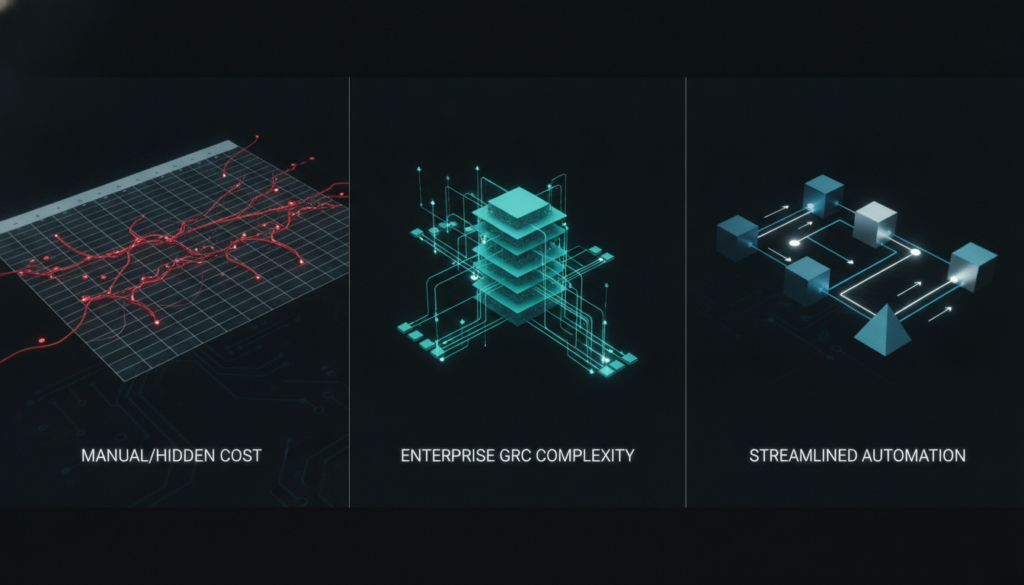
AI governance has a cost whether you formalize it or not. The question is whether you’re paying in software budget, in hours, or in incident exposure. This post breaks down what each approach actually runs — enterprise GRC platforms, purpose-built AI governance tools, and the spreadsheet path — so you can make a real comparison instead of guessing.
Why Enterprise GRC Platforms Are the Wrong Benchmark for AI Governance
When mid-market IT teams go looking for AI governance software, they often find enterprise GRC platforms first. ServiceNow IRM, OneTrust, MetricStream — these are serious platforms built for organizations with dedicated compliance teams, custom integration budgets, and 6-12 month implementation timelines. Pricing is typically not published. You fill out a form, get a discovery call, and eventually receive a quote in the range of $30,000 to $150,000+ annually, depending on modules, seats, and implementation scope. That range isn’t an exaggeration; it’s what the market looks like when the product is designed for Fortune 500 procurement cycles.
The implementation cost is where mid-market teams get surprised. Even if a vendor quotes you on the lower end, standing up an enterprise GRC platform requires mapping your controls architecture, configuring workflows, training administrators, and often paying a system integrator to do the parts the vendor won’t. For a 100-person company without a dedicated GRC analyst, that implementation work falls on whoever already owns IT security — meaning you.
Enterprise GRC platforms aren’t priced wrong for their intended buyer. They’re just built for a different problem than AI governance at mid-market scale. If you’re running AI tool risk assessments, building a policy library, and trying to document evidence for a customer questionnaire or an EU AI Act conversation, you don’t need a platform that handles SOX controls across 40 subsidiaries. You need something scoped to what you’re actually doing.
What Purpose-Built AI Governance Software Actually Costs
The purpose-built AI governance category is newer and more varied in pricing than enterprise GRC. Tools in this space — including InfoDefenders — are generally built around the actual workflow: discover what AI tools are in use, assess vendor and tool risk, document policies and controls, and produce evidence when someone asks for it. Pricing reflects that scope rather than the kitchen-sink feature set of enterprise GRC.
For most mid-market teams, this is the tier that makes practical sense. You’re not paying for modules you’ll never configure, and you’re not starting from zero every time an AI vendor questionnaire lands in your inbox.
At InfoDefenders, we’ve structured our pricing around the RAGP framework — React, Assess, Govern, Prove — so you can start where you actually are rather than buying a full platform on day one. The AI Incident Log (Starter tier) covers the React phase: logging and tracking AI-related incidents as they surface. The AI Risk Assessor (Professional tier) moves into Assess: structured vendor and tool risk evaluations. The AI Governance Manager (Governance tier) is where most mid-market teams settle for ongoing operations — policy library, controls ownership, evidence export. The Suite tier covers organizations that need full governance posture management across the business.
Purpose-built tools in this category typically run from a few hundred dollars per month for a starter configuration to a few thousand per month for a full governance tier, depending on seat count and feature scope. The operational model is meaningfully different from enterprise GRC: you can be live in days rather than quarters, and there’s no systems integrator standing between you and a working product.
For a practical comparison: at the mid-range of purpose-built AI governance software pricing, you’re looking at roughly what you’d spend on one week of a consultant’s time — but the tool keeps running after the engagement ends.
The Hidden Cost of DIY AI Governance Spreadsheets
Back to the spreadsheet question, because it deserves an honest answer rather than a vendor’s dismissal.
A spreadsheet can hold an AI tool register. It can track incident dates. It can store a copy of your AI use policy. For a 10-person company with two AI tools in active use, that might genuinely be sufficient. For a 100-person company where shadow AI has already taken hold — employees using unapproved AI tools for customer-facing tasks, code generation, or data analysis without IT visibility — a spreadsheet is where governance goes to die quietly.
The hidden cost isn’t the spreadsheet itself. It’s the labor that props it up. Someone has to build the initial register, which means first figuring out what AI tools are actually in use across the organization. That discovery process, done manually, typically takes an IT manager several days of work: auditing SaaS spend reports, reviewing browser extension installs, sending department surveys, following up on non-responses. Once the register exists, someone has to maintain it — updating vendor entries when tools change, re-evaluating risk when a new model version ships, flagging expired vendor certifications.
The labor cost compounds quickly. At a conservative estimate of $60 per hour for an IT manager’s loaded cost, 10 hours of initial buildout plus 3 hours per month of maintenance runs you about $2,760 in the first year. That’s before you account for the time spent reformatting the spreadsheet every time a customer sends a vendor questionnaire in a different format, or rebuilding it when the person who built it leaves the company.
The spreadsheet also has no audit trail, no version history that tells you when a risk rating changed and why, and no way to export a clean evidence package when your next enterprise customer asks for documentation of your AI governance program. Those gaps don’t matter until they do — and when they do, they tend to matter at the worst possible moment.
AI Governance Pricing in Context: What You’re Actually Buying
The honest framing for any AI governance software decision is this: you’re not buying a feature list, you’re buying time back and risk off the table.
A purpose-built AI governance tool replaces the initial buildout labor, the ongoing maintenance burden, and the scramble when someone needs evidence. It also replaces the cognitive load of remembering what’s in the register, which vendors have outstanding risk items, and which policy needs a refresh. For an IT manager running AI governance alongside three other priorities without a dedicated compliance team, that’s the real value proposition.
Enterprise GRC is worth its price for organizations that have the team and complexity to use it. DIY spreadsheets are a starting point, not a governance program. Purpose-built tools fill the gap that actually exists at mid-market scale.
One factor that’s shifting the calculus: customer pressure. Enterprise procurement teams are increasingly asking mid-market vendors about AI governance as part of their vendor risk process. If you’re a 150-person SaaS company selling into regulated industries, being asked to document your AI governance program is no longer a hypothetical — it’s showing up in questionnaires today. A spreadsheet is a harder answer to that question than a structured program with exportable evidence.
For organizations with EU exposure, the EU AI Act adds another dimension. Obligations under the Act vary by AI system risk classification, but the expectation of documented governance is consistent across tiers. A purpose-built tool that maps to recognized frameworks makes that documentation substantially easier to produce than a spreadsheet that you’d have to manually translate into whatever format the regulator or auditor expects.
Do This Week: Price the Option You’re Not Considering
If you’re currently managing AI governance in a spreadsheet (or planning to), run this calculation before you decide that’s the right long-term answer. Estimate how many hours you’ve spent in the last quarter on AI tool discovery, risk documentation, and policy maintenance. Multiply by your hourly loaded cost. That’s your current run rate for DIY governance.
Then look at what a purpose-built AI governance tool would cost for your headcount and use case. The comparison is often closer than IT managers expect — and that’s before factoring in the evidence export problem, the audit trail gap, or the next customer questionnaire.
If you want a starting point for organizing what you already know about your AI tool footprint, download the free AI tool register template — it’s the same structure we use in the AI Risk Assessor, and you can start populating it before you make any software decision.
For teams that are ready to move off the spreadsheet, see AI governance pricing for InfoDefenders’ tiers — Starter through Suite — so you have a real number to put in your comparison, not a “contact sales” placeholder.
If you’ve already made the move from a readiness engagement or a manual process and are thinking about how a SaaS handoff works operationally, From Readiness Engagement to SaaS: A 90-Day Handoff covers that transition in detail.