The Part of AI Agents Nobody Talks About in the Risk Briefing
Every conversation about AI agent risk eventually circles back to the model — which LLM it’s running, who built it, whether it hallucinates. That’s the wrong place to focus. The model is the least interesting part of the risk picture. What matters is what you’ve wired it into.
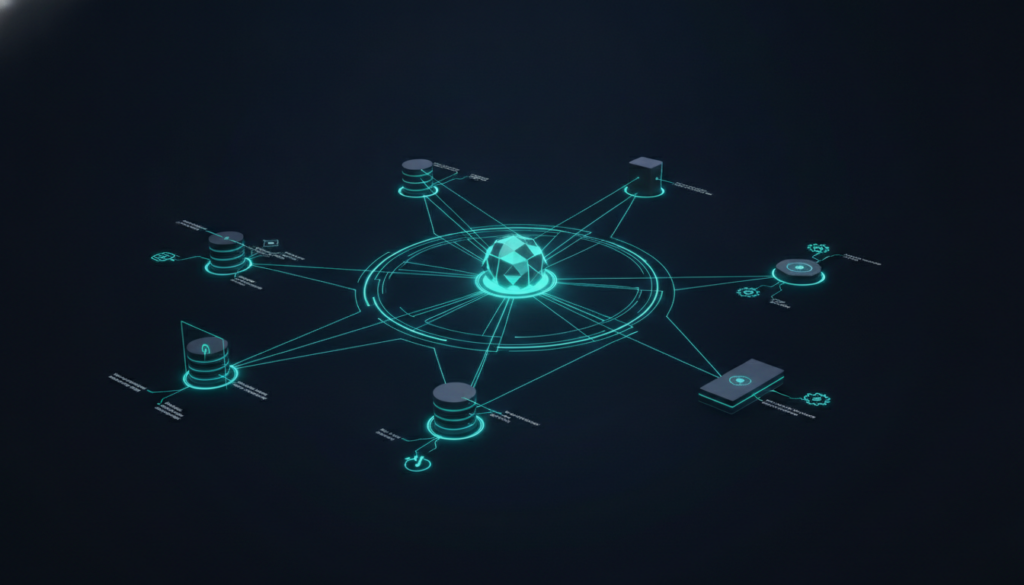
AI agents aren’t just chat interfaces. They’re automated decision-makers that can call APIs, read and write files, send emails, query databases, and trigger workflows — often with minimal human review between steps. The LLM is just the reasoning engine in the middle. The actual exposure comes from the permissions you grant, the data sources you connect, and the actions you allow. Get that configuration wrong and you’ve handed an autonomous system the keys to parts of your environment that your own employees couldn’t access without an approval process.
This is where AI agent risk management gets serious for IT teams at mid-market companies. You’re not running a research lab. You’re running a business where someone on the ops team just connected an AI agent to your CRM, your support ticketing system, and your email — because the vendor made it look easy in the setup wizard.
Why AI Agent Risk Management Differs From Standard AI Tool Risk
When you assess a standard AI tool — say, a writing assistant or an image generator — the risk profile is mostly contained. The tool takes input, produces output, and the human decides what to do with it. The blast radius of a bad output is usually limited to the person who prompted it.
Agents are different by design. The defining characteristic of an agentic system is autonomy over action. An agent doesn’t just suggest; it does. It reads a customer complaint, drafts a reply, checks your refund policy, looks up the order in your ERP, and processes the refund — all without a human in the loop. That’s the value proposition. It’s also exactly where the risk concentrates.
The practical consequence is that the risk questions you ask about a regular AI tool don’t transfer cleanly to agents. “Does it retain my data?” matters less than “What can it do with my data once it has it?” “Is the model trustworthy?” matters less than “What’s the scope of its system prompt, and who controls it?” “Did we vet the vendor?” matters less than “What API keys did we hand it, and what permissions do those keys carry?”
Most AI vendor risk frameworks haven’t caught up to this yet. They’re still asking checklist questions designed for passive tools, applied to systems that can take real-world actions on your behalf.
The Four Places AI Agent Risk Actually Lives
If you’re trying to get your arms around the risk surface of an AI agent deployment, here’s where to look — in order of how often things go wrong in practice.
Integration scope. Every API connection an agent holds is an attack surface and an insider risk vector. If your customer-facing support agent has a connection to your billing system, a misbehaving agent — whether from a bad prompt, a compromised session, or a logic error — can take billing actions. Map every integration before you sign off on a deployment. The question isn’t just “what does this agent need access to?” It’s “what’s the minimum access that makes it functional, and have we scoped permissions to that minimum?”
Data access boundaries. Agents often need context to work well, so vendors design them to ingest broadly — conversation history, user records, company files, support tickets. That broad ingestion is frequently misconfigured by default. An agent trained or RAG-fed on internal documentation may surface information to users who wouldn’t otherwise have visibility into it, simply because the permission boundary on the knowledge base doesn’t match your actual access control model. This is a shadow AI problem even inside sanctioned deployments — the data exposure happens quietly, not as a visible incident.
Action reversibility. This one gets underweighted consistently. When an agent takes an action — sends an email, submits a form, writes to a record, triggers a webhook — can that action be undone? Define that before deployment, not after the first bad run. For any action category that’s irreversible or hard to reverse, you need either a human-in-the-loop confirmation step or a hard technical limit on the agent’s ability to take that action without review. The agent shouldn’t be the one deciding when its own actions are too consequential to proceed autonomously.
Prompt and instruction control. The system prompt is the governance document for an AI agent. It defines scope, persona, constraints, and escalation behavior. If it’s written by a vendor, sitting in a configuration file nobody on your team has read, and not subject to change control — that’s a governance gap. Your IT or security team should be able to answer, without digging, what instructions govern this agent, who last updated them, and whether they’ve been reviewed against your acceptable use policy.
What Good AI Agent Governance Looks Like in Practice
Regulating the model isn’t sufficient. Governing the agent means governing its configuration, its connections, and the controls that constrain its actions. That breaks down into three things you can operationalize right now.
First, treat every AI agent as a distinct entry in your AI tool register, not as a feature of the underlying platform. A company running three different agents on the same LLM has three different risk profiles — because each agent has different integrations, different data access, and different action permissions. If your AI tool inventory doesn’t differentiate at the agent level, it’s not capturing the actual risk.
Second, require an integration map as a condition of deployment approval. Before any agent goes into production, document every API it calls, every data source it reads or writes, and every action category it’s authorized to take. This doesn’t need to be a formal architecture diagram — a structured spreadsheet entry in your risk registry is fine — but it needs to exist, be signed off by whoever owns the connected systems, and be revisited when the agent’s scope changes.
Third, build a review trigger for prompt changes. System prompts change. Vendors update them. Internal admins tweak them. If nobody on your team is notified when the instructions governing an agent change, you’ve lost control of that agent’s behavior. Treat prompt updates the same way you’d treat a policy change: logged, reviewed against your acceptable use policy, and approved before deployment.
These three controls don’t require an enterprise GRC platform. They require discipline and a place to put the records.
AI Agent Risk and Regulatory Exposure
For companies with any EU exposure, the EU AI Act is worth understanding here specifically. Agentic systems that make decisions affecting individuals may qualify as high-risk AI systems under the Act, particularly in sectors like HR, credit, or customer account management. Even if your agent sits in a lower-risk category, the Act’s general-purpose AI provisions and transparency requirements apply to how you deploy and document these systems — not just to the model provider.
The NIST AI Risk Management Framework (NIST AI RMF) addresses this through its “Map” function, which asks organizations to identify the context of AI deployment — including human interaction, autonomy level, and the potential for consequential decisions. An AI agent that takes actions without human review sits at the high-autonomy end of that spectrum, and the framework expects higher rigor in your risk controls to match.
Neither framework is asking you to ban agents. They’re asking you to be deliberate about what you let them do and to document that deliberateness.
Do This Week: Build an Agent-Level Risk Entry
If you have an AI agent running anywhere in your environment today — whether it’s a customer support bot, an internal IT helpdesk agent, or a vendor-provided workflow automation — pick one and build a proper risk entry for it. Answer five questions:
- What integrations does this agent hold, and what permissions does each connection carry?
- What data sources does it read or write, and do the access controls on those sources match your intended data access model?
- What action categories can it take, and which of those are irreversible without escalation?
- Who controls the system prompt, and when was it last reviewed?
- Who owns this agent from an IT governance standpoint — and do they know it?
If you can’t answer all five, you have a gap. That gap is where the real AI agent risk sits, not in the model card the vendor put together.
Once you’ve done it for one agent, you have the template for all of them. That template belongs in your AI risk registry alongside your other tool entries — because an agent is a tool, but it’s a tool with teeth.
If your current AI tool inventory isn’t structured to capture integration scope and action permissions at the agent level, the free AI tool register template from InfoDefenders gives you a starting point built for exactly this kind of operational detail. Or if you want to see how your broader AI governance posture stacks up before you go deeper, the free RAGP maturity assessment will tell you where the gaps are across your full AI program.