Most AI governance programs fail in the first six months, and the failure usually starts on a Tuesday afternoon when someone decides to write an AI policy.
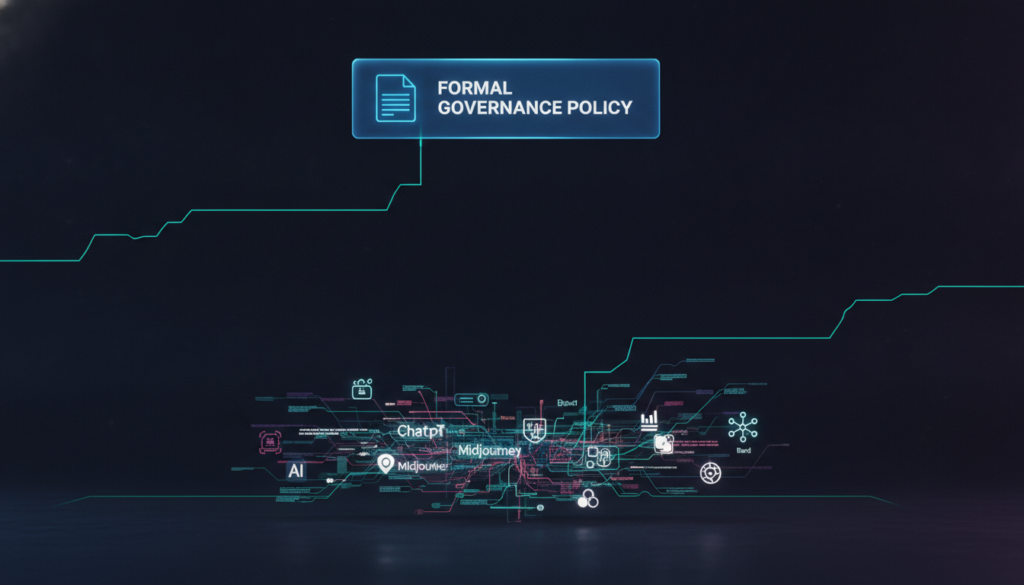
That sounds backwards. Isn’t a policy the point? It’s what leadership wants to see. It’s what an auditor asks for. It satisfies the board-level ask of “do we have something in writing?” So organizations sit down, pull together a template or two, draft acceptable-use language, get legal to sign off, and publish it on the intranet. Box checked.
The problem is that the policy was written without anyone actually knowing what AI tools the organization is using, how they’re being used, or what’s already gone wrong. It’s not a governance document. It’s a guess dressed up as one.
The Visibility Problem Nobody Talks About
Here’s what’s actually happening inside most SMBs right now: employees are using AI tools — ChatGPT, Copilot, Grammarly, AI-assisted CRM features, whatever ships inside the SaaS stack they already pay for — and nobody in IT has a clear picture of the full scope. Some of it is sanctioned. A lot of it isn’t. Some of it involves data that absolutely should not be going into a third-party model.
When you write a policy before you have visibility into that reality, you’re writing rules for a situation you haven’t mapped. The policy will prohibit things people aren’t doing and permit things they are. And critically, it won’t reflect the risk profile that actually exists in your environment, because you don’t know what that profile is yet.
This isn’t a compliance theory problem. It’s an operational one. The first time something goes wrong — a data handling incident, a vendor that turns out to be storing prompts, an output that exposes sensitive information to the wrong person — the policy offers no traction because nobody built the habit of noticing problems in the first place. There’s no incident log. There’s no pattern. There’s no evidence that governance was actually happening. There’s just a document.
What “First Contact” Actually Looks Like
Imagine an employee uses an AI writing tool to draft client communications, and it turns out the tool’s data retention policy means those drafts — including client names and account context — have been sitting on a vendor’s servers for six months. That’s a reportable incident in some regulatory environments, a contract breach question in others, and a client trust issue in all of them.
Now you go to your AI policy. It says employees should use “approved tools” and “exercise judgment with sensitive data.” That language didn’t prevent the problem, and it doesn’t help you respond to it. You don’t know how many employees used the same tool, for how long, or what data was involved, because there was never a mechanism for anyone to report or log AI-related issues in the first place.
This is where governance programs collapse — not under regulatory scrutiny, but under the weight of the first real incident they were supposed to handle.
The Order Actually Matters
The sequence that works is the inverse of what most organizations do. You need visibility before you can assess risk. You need to assess risk before you can write policy that reflects it. And you need policy and controls in place before you can prove your governance posture to anyone outside the organization.
This is the logic behind the framework we use at InfoDefenders, called RAGP: React, Assess, Govern, Prove. The name will come up again in this blog, so it’s worth a quick definition: React is about building the habit of capturing AI-related incidents and anomalies before they become crises; Assess is the structured evaluation of AI tool and vendor risk; Govern is where policy, controls, and ownership actually live; and Prove is how you demonstrate the whole thing is working. The reason the order exists is that each phase depends on the output of the one before it. You can’t write a policy that governs something you haven’t assessed. You can’t assess something you have no visibility into.
Starting with policy isn’t just inefficient — it actively creates a false sense of readiness that makes the eventual reckoning worse.
What to Do Instead
Before you open a policy template, spend two weeks answering a simpler question: what AI tools are actually in use in this organization, and has anything gone wrong with them that nobody formally recorded?
That second part is the harder question. “Nothing has gone wrong” is almost never the accurate answer — it’s usually “nothing has been formally recognized as wrong.” Employees encounter unexpected outputs, share data they shouldn’t have, use tools in ways that weren’t intended, and quietly move on. None of it gets logged. None of it informs policy. None of it shows up until something forces it to.
Building even a lightweight incident-logging habit — a shared mechanism where someone can say “this tool did something unexpected with this type of data” — changes the quality of everything downstream. Your risk assessments get grounded in actual behavior rather than hypothetical scenarios. Your policies address real exposure instead of theoretical ones. Your controls close actual gaps.
The organizations that have functional AI governance programs didn’t start with better policies. They started by paying attention first.
If your program is policy-first right now, that’s not a reason to scrap what you have — it’s a reason to go back and build the foundation it’s currently missing. Start logging. Start asking what’s actually in use. The policy will get better once it’s connected to something real.