What a Successful AI Governance Consulting Handoff Actually Looks Like
Most AI governance projects stall at the same place: the consulting engagement wraps up, a report lands in someone’s inbox, and six months later nothing has changed. The policies are still drafts. The tool inventory is still a spreadsheet someone stopped updating. The organization is back to square one, except now they’ve spent money on it.
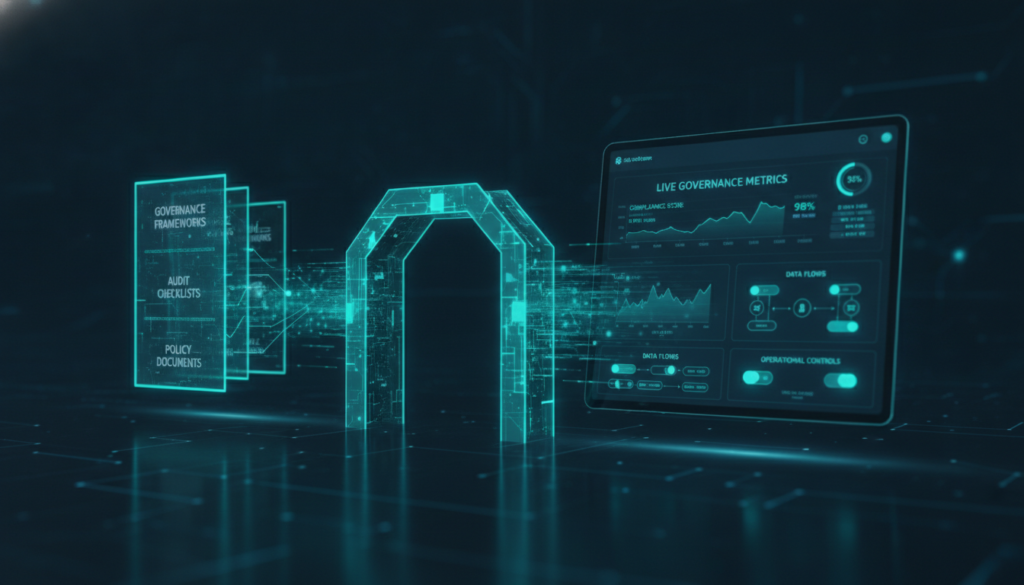
This post documents a pattern we’ve run with clients that breaks that cycle — a 90-day sequence where a fixed-fee readiness engagement establishes the baseline, and a structured handoff moves ongoing operations into the SaaS platform without losing the momentum the engagement built. The client here is anonymized, but the mechanics are real and repeatable.
Why Mid-Market IT Teams Struggle to Govern AI Without a Starting Baseline
The client that prompted this pattern was a professional services firm with around 150 employees. Their IT function was a two-person team. They had no dedicated compliance staff, no formal AI use policy, and no visibility into which AI tools their workforce had actually adopted. They knew they had exposure — a few enterprise contracts were starting to include AI governance addendums, and they had customers with EU operations asking questions about data handling — but they didn’t know where to start.
That’s a situation a lot of mid-market IT teams find themselves in right now. Shadow AI has made the inventory problem worse than it used to be: employees adopt AI tools at the individual or team level, often without procurement involvement, and IT ends up governing tools they don’t know exist. Before you can build policy, assign ownership, or run a vendor risk assessment, you need to know what you’re actually dealing with. Without that foundation, any governance program you try to build is working from a flawed picture.
The consulting engagement existed precisely to solve this. Before handing off to a SaaS platform, someone has to do the discovery work.
How the Fixed-Fee Readiness Engagement Built the Foundation
The client selected InfoDefenders’ standard readiness tier. The engagement scope covered three deliverables: an AI tool inventory, a gap assessment against a baseline control set, and a first-draft AI use policy.
The tool inventory was the most labor-intensive piece. We ran structured interviews with department leads — not just IT, but operations, finance, and client services — and cross-referenced what people said they were using against what the IT team could see in SaaS spending data and browser extension logs. The honest answer is that neither source alone gives you the full picture. Interview data surfaces the tools people use personally or on mobile; spend data surfaces sanctioned subscriptions that may have been expanded without IT’s knowledge.
By the end of that discovery process, the client had a documented AI tool register: each tool listed with its function, the team using it, the data categories it touched, and a preliminary risk tier. That register became the foundation for everything that followed. It also confirmed what the IT lead had suspected — several tools were processing client data in ways that hadn’t been reviewed by anyone.
The gap assessment mapped what they had against a baseline that drew on NIST AI RMF concepts and the control areas most relevant to their EU-exposed contracts. The AI use policy draft gave them something to actually socialize and adopt, rather than starting from a blank page.
Four weeks in, the readiness deliverables were complete. The question was how to keep this from becoming a shelf document.
The 90-Day Handoff: Moving Ongoing AI Governance Operations to SaaS
The handoff started at week five, while the consulting engagement was still technically active. That overlap is intentional and, in our experience, critical. If you hand off at the end of the engagement and walk away, you’re recreating the same dynamic that causes governance programs to stall.
We onboarded the client’s IT lead onto InfoDefenders’ AI Risk Assessor (PROFESSIONAL tier) during the final two weeks of the engagement. The AI tool register we’d built together was the seed data. Rather than importing a static spreadsheet, we walked through each tool in the register and ran it through the platform’s risk assessment workflow — so the IT lead understood the methodology and wasn’t just inheriting a black box.
That matters more than it sounds. If the person responsible for ongoing governance doesn’t understand why a tool was tiered the way it was, they can’t make a reasonable call when a new tool comes in six months later. The handoff period is a teaching moment, not just a data migration.
By the end of week eight, the client had moved from a consulting deliverable to an operational posture. Their AI tool inventory was live in the platform, each entry had a risk tier and a designated owner, and the AI use policy had been formally adopted. They were also logging incidents — not because they had a crisis, but because they’d started treating AI risk the same way they treated any other operational risk category: something you track, not just something you react to.
At week twelve, we did a structured review. The IT lead had added four new tools to the register independently, closed two open risk items, and flagged one vendor for a follow-up assessment based on a terms-of-service update. The governance program was running on its own momentum.
What Actually Transferred — and What Didn’t
A few things worked better than expected. The tool register was the most durable artifact from the engagement. Because it had been built collaboratively and tied to a platform workflow, the IT lead treated it as a living document rather than a completed project. That’s not guaranteed — it depends heavily on how the handoff is structured — but the overlap period made the difference.
The policy was harder. The first draft we produced was directionally right but needed two rounds of internal review before adoption. That’s normal, and it’s not a failure of the engagement — policy adoption is a people problem as much as a documentation problem. What we’ve learned is to build that review cycle into the handoff timeline explicitly, rather than assuming it happens on its own.
The one thing that didn’t transfer cleanly was incident logging. The client understood the concept and had the AI Incident Log available at the STARTER tier, but using it consistently required a habit change that took longer than twelve weeks to fully take hold. That’s a realistic expectation to set upfront.
Lessons IT Managers Can Apply to Their Own AI Governance Handoff
If you’re looking at a similar path — starting with an outside engagement and transitioning to internal operations — a few things from this pattern are worth internalizing.
First, the inventory has to come before the policy. Every time we’ve seen organizations try to write an AI use policy without a current tool register, the policy ends up either too vague to be enforceable or too specific about the wrong tools. The AI tool inventory isn’t a phase you skip to get to the more visible deliverables faster.
Second, the handoff period is not a handoff document. A 30-page report dropped at the end of an engagement doesn’t transfer operational ownership. Overlap time — where the internal owner is actually running the platform alongside the consultant — is what builds the muscle memory for ongoing governance.
Third, keep the scope of ongoing operations narrow at first. The client in this case started with three active priorities: maintaining the tool register, completing the open risk assessments, and achieving policy adoption. They didn’t try to build a full controls library or run a maturity assessment in the first quarter. Mid-market AI compliance doesn’t require doing everything at once; it requires doing the right things in the right order.
Finally, pick your platform before the engagement ends, not after. If you wait until the consulting work is complete to evaluate SaaS options, you’re introducing a gap where the work can stall. The platform decision should be part of the engagement scoping conversation.
If you’re already past the “should we do something about AI governance” question and want to see what the ongoing operations layer looks like, take the free RAGP maturity assessment to see where you currently stand across the four phases — and where the gaps are before you start building.