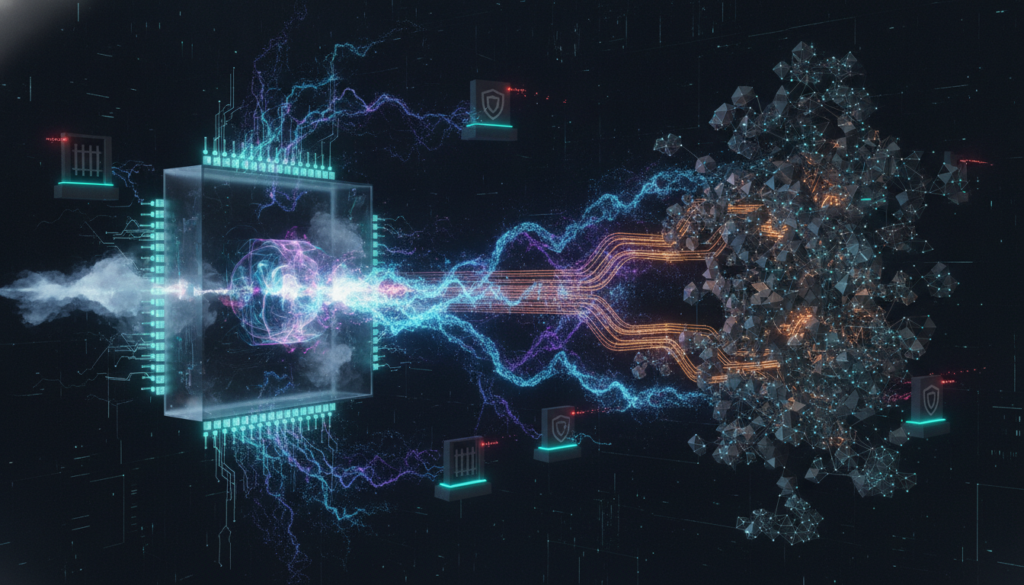
According to OECD.AI, quantum technologies are increasingly complementary to AI systems, with potential to dramatically accelerate model training, optimization, and inference at scales current hardware can’t touch. That’s a future-state claim, but the governance implication is present-tense: the AI tools your teams are already using are being built by vendors who are actively experimenting with these capabilities. You probably don’t know which ones, and your vendor risk process almost certainly doesn’t ask.
The Governance Gap Quantum-AI Exposes
Here’s the actual problem. Most mid-market companies have picked up a handful of AI tools over the last two years — a writing assistant, a coding copilot, maybe an AI-assisted customer support platform. Some of those tools have gone through informal IT review. Most haven’t. And the review that did happen probably focused on data handling and SSO support, not on what the vendor’s underlying model architecture is, where training compute runs, or what third-party infrastructure they’re licensing.
Quantum-AI convergence doesn’t change that gap. It makes it more visible. When a vendor starts using quantum-accelerated training or inference infrastructure — and some are already experimenting — the risk surface changes. Model behavior can shift in ways that aren’t obvious from the outside. The vendor’s own understanding of how the model produces outputs may decrease, not increase. That’s not speculation; it’s one of the documented challenges the OECD series acknowledges in examining AI-quantum integration.
If you don’t have a baseline record of what AI tools are deployed, which vendors supply the underlying models, and what your contractual rights are around model changes, you have no way to assess that shift when it happens. You’re not governing AI. You’re just hoping the vendors are.
What This Actually Means for Your Tool Inventory
The practical issue isn’t quantum computing itself — you don’t need to understand qubit coherence to manage AI governance well. The issue is that AI vendors are moving faster than most procurement and vendor risk processes, and quantum-AI development is one more signal that the gap is widening.
A few things tend to be missing from mid-market AI vendor reviews:
- No documented record of which model version a vendor is running or when it last changed
- No clause in the contract requiring notice before material model updates
- No defined process for re-evaluating a vendor after a significant infrastructure change
- No owner accountable for tracking that information over time
None of those gaps require a compliance team to fix. They require someone to own the process and a lightweight structure to run it through.
Do This Week
Pull the list of every AI tool your organization is currently paying for or actively using — include the shadow IT ones if you can get them. For each one, answer three questions: Who is the actual model provider (the vendor you pay, or a third party they license from)? What does your contract say about material changes to the model or infrastructure? And when did someone last look at this vendor’s risk posture?
If you can’t answer those questions for more than half your list, that’s your starting point — not a framework gap, not a policy gap. A basic inventory gap. Fix the inventory before you worry about quantum.
Once you have the inventory, you can start running structured vendor risk assessments against each tool. That’s exactly what the AI Risk Assessment Agent in InfoDefenders’ PROFESSIONAL tier is built for — a repeatable process that produces defensible documentation, not a one-time checkbox.
Why This Matters Now, Not Later
Quantum-AI isn’t a five-year problem you can defer. It’s a two-year forcing function on a governance process you should have started building last year. The OECD framing is forward-looking, but the organizations asking hard questions about AI vendor risk today are the ones who won’t be scrambling when their auditor, their customer, or their regulator asks about it first.
Mid-market IT teams don’t have the luxury of waiting for the enterprise GRC playbook to trickle down. You’re making real decisions about real tools right now, with real data flowing through them. The governance infrastructure has to keep pace with that, not lag three technology cycles behind it.
The quantum conversation is a useful forcing function precisely because it’s unfamiliar. It makes people ask “wait, do we even know what’s inside this vendor’s stack?” That’s the right question. Start there.
—
Not sure where your AI vendor risk process stands today? InfoDefenders helps mid-market IT teams track tools, run structured risk assessments, and build audit-ready governance evidence — see plans and pricing.