The Problem With “I Agree”
If someone on your team clicked through your AI acceptable use policy six months ago, can you prove it? Can you prove which version they acknowledged? Can you prove their role at the time, so you know whether the right controls applied to them? If the answer to any of those is “I’d have to dig through email,” your AI policy acknowledgment process isn’t a control — it’s a record-keeping problem waiting to become an audit problem.
This matters more now than it did two years ago. Regulators and frameworks from NIST to the EU AI Act are converging on the same expectation: that organizations can demonstrate ongoing human accountability for AI use, not just prove that a policy document exists somewhere. Acknowledgment is one of the mechanisms that closes that loop. Done badly, it’s theater. Done well, it’s evidence.
What “Checkbox Theater” Actually Looks Like
The typical policy acknowledgment flow at an SMB goes something like this: IT drafts or adopts an AI acceptable use policy, drops it into a shared drive or the company intranet, sends a company-wide email asking people to “review and acknowledge,” and collects replies or clicks. Done. Box checked.
The problems compound quietly. Six months later the policy gets updated — maybe because a new AI tool got added to the approved stack, or because a vendor changed their data retention terms. A revised document gets posted. Another email goes out, or doesn’t. Nobody’s sure who saw what version. The HR manager who just joined last month was never assigned the acknowledgment at all. The developer who uses the highest-risk AI tools acknowledged the version that didn’t include the data classification requirements that now apply to her role.
When something goes wrong — a data exposure, a regulatory inquiry, an insurance claim — that paper trail doesn’t hold up. You can’t tell an auditor which version of the policy was in effect, who it covered, and whether the people handling sensitive data actually acknowledged the controls that applied to them.
What Defensible Acknowledgment Actually Requires
Defensible AI policy acknowledgment has four components that have to work together. None of them are complicated, but they all have to be present.
Version control tied to the acknowledgment record. Every acknowledgment needs to point to a specific, immutable version of the policy — not just “the AI acceptable use policy” as a concept. When you update the policy, you need a new version identifier, a publication date, and a mechanism that distinguishes who acknowledged v1.2 versus who has or hasn’t yet acknowledged v1.3. If your acknowledgment system can’t tell you which version a given employee signed off on, it can’t tell you anything useful.
Role-based assignment. Not every employee needs to acknowledge every policy at the same depth, but the people whose roles create elevated risk need to be tracked explicitly. Your data engineers using a code-generation tool with internet connectivity have different exposure than an office manager who occasionally uses an AI writing assistant. A defensible process assigns acknowledgment requirements based on role, so you can demonstrate that the controls relevant to a given job function were communicated to — and acknowledged by — the people actually doing that job.
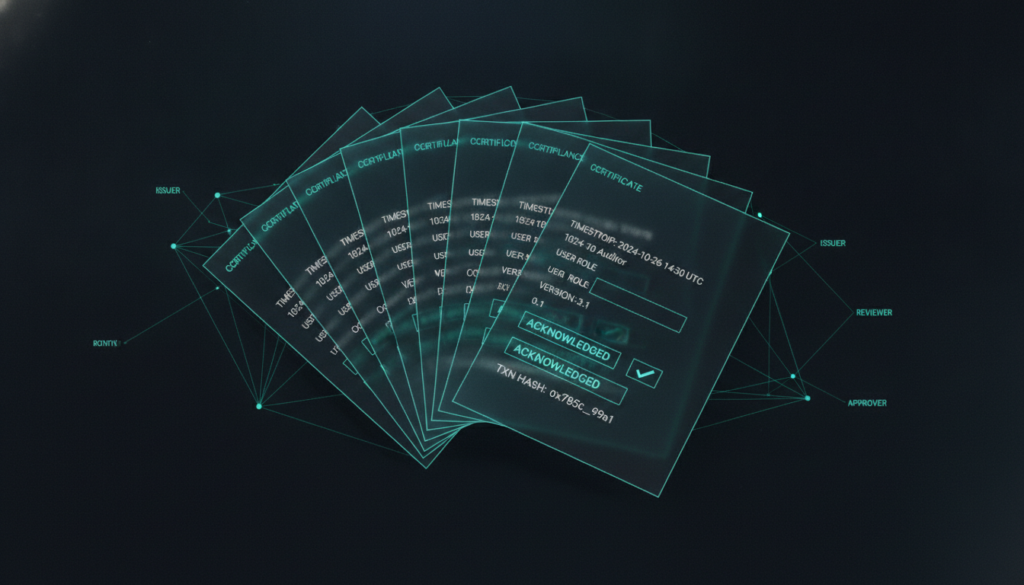
A timestamped, tamper-evident audit trail. The acknowledgment record needs to capture who acknowledged, when, from what role, and against which policy version. “We have a spreadsheet” doesn’t meet that bar, because spreadsheets can be edited after the fact and don’t capture the metadata an auditor needs. The record should be write-once, or at minimum export to an immutable format you can produce on demand.
A defined process for policy changes. This is the one most organizations skip entirely. When the policy changes, what triggers a new acknowledgment cycle? Who decides? How long do employees have to complete it? What happens if someone doesn’t? You need a documented change-management process for the policy itself, not just for the acknowledgment event. Otherwise every update is a one-off scramble, and the audit trail looks exactly like what it is.
The EU AI Act and NIST AI RMF Aren’t Asking for Much — But They Are Asking
You don’t have to be a compliance expert to understand what’s coming from a regulatory direction. The EU AI Act requires providers and deployers of higher-risk AI systems to maintain documentation and implement human oversight measures. For deployers — which includes most companies using third-party AI tools in business processes — that means being able to show that the people operating those systems understood the relevant constraints. Acknowledgment of AI use policies is one of the most direct ways to demonstrate that.
The NIST AI Risk Management Framework makes the same point from a risk governance angle: the GOVERN function specifically calls for organizational practices that make AI risk accountability visible and traceable. Policy acknowledgment is a foundational piece of that traceability.
Neither framework is prescribing an exact technical implementation. What they’re establishing is a standard of care — and that standard is higher than “we sent an email.”
A Practical Look at What This Should Look Like
Here’s a concrete picture of a functional AI policy acknowledgment process for a company with, say, 120 employees and a handful of approved AI tools.
The IT manager maintains a policy library with version numbers and effective dates. Right now there are three AI-related policies: an acceptable use policy, a data classification standard for AI tools, and a vendor review policy for new AI tool requests. Each one has a current version in the library and an archive of prior versions.
When a new employee onboards, they’re automatically assigned acknowledgment tasks based on their role. Everyone gets the acceptable use policy. Anyone in a technical role or with data access gets the data classification standard too. The acknowledgment isn’t a passive “click to confirm you read this” — it’s a dated record tied to their employee ID, their role at time of acknowledgment, and the specific version of each document.
When the acceptable use policy is updated, the IT manager publishes v1.4 with a new effective date and triggers a new acknowledgment cycle. The system shows a completion dashboard: 94 of 120 employees have acknowledged v1.4 within the required window, 26 haven’t. The IT manager can see exactly who’s outstanding and send targeted reminders. Employees who haven’t completed acknowledgment within the deadline get escalated to their managers.
At the end of the quarter, when the company’s cyber insurance carrier asks for evidence of AI governance controls, the IT manager exports a timestamped acknowledgment report: every employee, every policy version, every acknowledgment date, with role context. That’s a one-click conversation instead of a three-day reconstruction project.
This isn’t a fantasy scenario. It’s what a functional acknowledgment process looks like, and it doesn’t require an enterprise GRC platform or a compliance team to run.
Do This Week
Before you invest in any tooling, get a clear picture of what you actually have. Pull your current AI-related policies — acceptable use, data handling, whatever you’ve got — and answer three questions:
First, does each policy have a version number and an effective date on the document itself? If not, assign one today. Even retroactively calling your current document “v1.0, effective [today’s date]” is better than nothing, because it gives you a baseline to version from.
Second, do you have a record of who acknowledged each policy, and does that record tell you *which version* they acknowledged? If your acknowledgment history is a pile of email replies or a checkbox in your HRIS with no version metadata attached, you know your first gap.
Third, do you have a list of which roles in your organization carry elevated AI risk — meaning the people who use AI tools with access to sensitive data, customer records, or code repositories? That list is your starting point for role-based acknowledgment assignment.
You can do all three of this in an afternoon. The output is a clear picture of what you have and what’s missing, which makes every subsequent decision easier.
If you’re at the point where you need a system that handles version tracking, role-based assignment, and audit-ready evidence export in one place, that’s exactly what InfoDefenders’ AI Governance Manager is built for — it manages your policy library and acknowledgment records as a connected system, so your evidence is always current and exportable.
The Standard You’re Being Held To
AI governance documentation requirements are still evolving, but the direction is clear: regulators, insurers, and enterprise customers are increasingly asking for proof that AI use is governed, not just that governance documents exist. The acknowledgment record is one of the most auditable, concrete pieces of evidence you can produce.
The companies that will struggle in future audits aren’t the ones that haven’t written policies — most IT managers have gotten that far. They’re the ones that wrote a policy, sent an email, and called it done. The gap between having a policy and being able to prove it was communicated, understood, and acknowledged by the right people in the right roles is exactly where audit exposure lives.
Closing that gap doesn’t require a compliance team or a six-figure GRC implementation. It requires treating policy acknowledgment as an operational process with the same version control and audit rigor you’d apply to any other IT control. That’s a higher bar than most SMBs are currently meeting — and right now, that’s also an advantage for the ones who get there first.